The Decision Nobody Made
Why enterprises stopped executing their own value streams
When something breaks, your room asks six questions.
How bad is it. Why did it happen. What are our options. Who is responsible for fixing it. How do we stop it happening again. And the one that comes last, from whoever has the most to lose: why didn't we see this coming.
You answer five. The sixth gets a war room, a corrective action, and a promise. Eight months later the same class of failure arrives wearing different clothes, and your room asks the same six questions.
We have been asking operations leaders in manufacturing, aerospace and industrial services to walk us through their last serious disruption. Your reality may differ from what follows. What we keep finding surprised us enough that it seems worth checking against your own last crisis.
Walk it back five rungs
Take any failure and keep asking why. Most reviews stop after two.
A line goes down because a part is short. The part is short because the supplier shipped late. Two rungs, and the review closes with a supplier conversation and a scorecard.
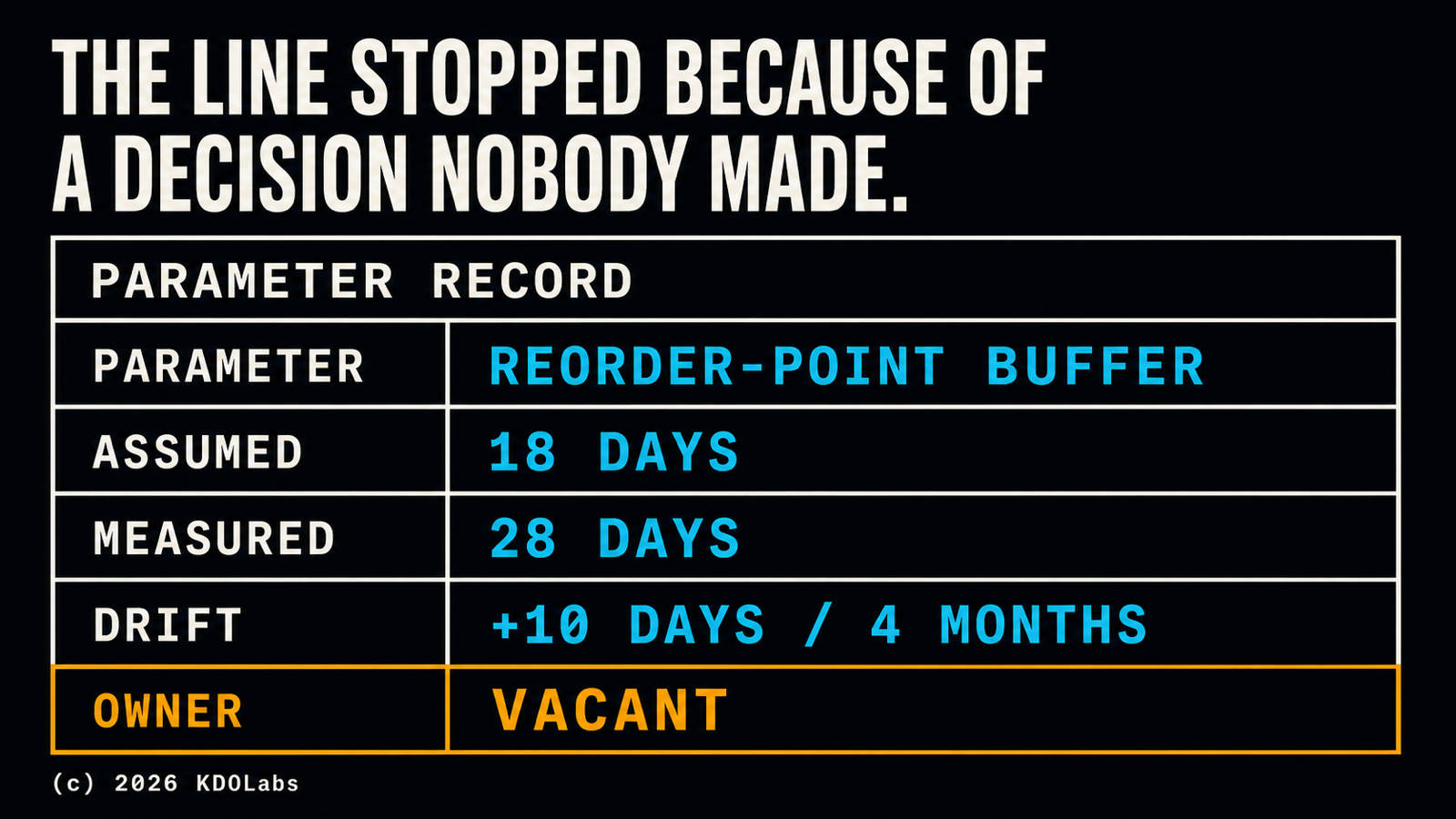
Keep going. Why did a late shipment matter this time, when that supplier has slipped before and you absorbed it? Because the buffer was too thin. Why was the buffer too thin? Because the lead time drifted from 18 days to 28 across four months, and the buffer parameter still assumed 18.
Now ask the fifth question. Who owns that parameter?
Every walkthrough we have done lands in the same place. Somebody set it years ago. That person changed roles. The system that consumes it belongs to planning, the data that would correct it sits in procurement, and the cost of getting it wrong lands on production. Nobody holds all three. So nobody recalculated it, and nobody was ever asked to.
The line stopped because of a decision nobody made.
The vacancy under the mechanism
Your last root cause review probably ended at "buffer was undersized." That is a mechanism. It tells you what moved. It says nothing about why nobody moved it back.
Under the mechanism sits a vacancy: a parameter, a threshold, a routing rule, a tolerance, with no name attached. Vacancies do not announce themselves. They surface as a crisis two quarters later, and by then the crisis looks like a supplier problem.
Count yours. The leaders we talk to carry hundreds. Each one is a quiet bet that the world will not move far enough to matter. Most of those bets pay, which is why you have so many.
You have more of these than you used to
You did not get worse at running your business. Three things happened to you.
You got bigger, and decisions that once fit in one person's head now span four functions and two continents. You bought companies, and each acquisition arrived with its own ERP, its own part numbers and its own inherited set of unowned parameters, which nobody inventoried. You digitised, and every new system took custody of a slice of a decision that used to belong to one manager.
Coordination cost now grows faster than output. Each plant, program and entity you add costs more to absorb than the last. Most executives feel that ceiling before they can name it, and it reaches the P&L as delivery slippage, working capital you cannot release, and an integration that never quite finished.
None of this needed artificial intelligence to go wrong. Your accountability chain broke from scale, on its own, years before anyone in your building said the word model.
Three fixes that do not close it
More visibility. You built the control tower, and it surfaces the shortage sooner. It does not tell you who owns the parameter that produced the shortage. You find out earlier and convene the same meeting.
More process. You add a review, a gate, a sign-off. Coordination cost was already the problem and you have bought more of it. The parameter still has no owner. It now has a committee, which is a way of having no owner with a calendar invite.
More AI. This one deserves care, because the technology works. Your model spots the drift and recommends the correction. Then it reaches a person who has to put their name on acting, and that person cannot see what the model saw, cannot price being wrong, and carries the fallout alone if it fails. So they escalate, or they wait. Model quality is not the blocker. Nobody will sign.
Stop improving decisions. Start forcing them.
The distinction carries more weight than it first appears.
You cannot compel a plant manager to release stock their own line needs. Their inventory, their delivery commitment, their call. Sovereignty over the decision belongs to whoever carries the consequence, and any system that takes it away is a system your best operators will route around within a quarter.
You can compel them to decide. On the record, with their name on it, inside a window. Silence stops being an option. Declining is fine, and often correct. Declining without anyone knowing you declined is what breaks.
So doing nothing becomes an act. Someone chooses it, prices it, signs it, and gets measured on how it turns out. A drifting lead-time parameter now has a person who decided this quarter not to recalculate it, and who can defend that choice with what they knew at the time. When the line stops two quarters later, you are not investigating a vacancy. You are reviewing a decision, and reviewing decisions is a conversation your organisation already knows how to have.
Vacancies close when somebody is required to stand in them.
Time is the asset
Every disruption runs on a clock.
At the moment the line stops, you have one option and it is the expensive one. Expedite, air freight, penalty, apology. Twelve days earlier, before anything visible has happened, you have dozens of options and most cost close to nothing. The same event, priced two orders of magnitude apart, depending only on when you meet it.
The asset you are building is that interval.
Each decision you close with a name, a reason and a measured outcome teaches you how failures form in your business. The pattern behind this shortage becomes recognisable eight days out instead of two. Then twelve. Then twenty. Every disruption you meet further upstream is one you settle with a cheaper option, and the interval keeps widening as long as you keep the record.
That last condition does the work. Decisions nobody signed teach you nothing, because you cannot tell which ones were sound, who made them, or what followed. A business that does not keep its decisions rents its judgement and starts over at each crisis. One that keeps them compounds.
What to do on Monday
Take your last significant disruption. The one that cost real money and produced a corrective action nobody has opened since.
Walk it back five rungs, past the mechanism, until the ladder stops. Then ask who owned the thing that drifted.
If you land on a name, your accountability chain held. Somebody made a judgement call and it went the wrong way, which happens in every business worth running, and which you already know how to manage.
If you land on a vacancy, you have just seen the shape of your next crisis.
We would like to hear what you find. We have been wrong about specific industries before, and these walkthroughs teach us more than they teach the people who sit through them.