Autonomous Operational Intelligence
The intelligence
autopilot
for operations.
A continuous intelligence capability across business functions.
AEIP continuously detects changing conditions, assesses their impact, investigates causes and prepares decision packages using current evidence and prior knowledge—giving teams more capacity to improve performance, pursue growth and scale operations.
Connected operational knowledge is the foundation: the relationships, conditions and experience that explain how the business works.
1:50 illustrative executive explainer · Click to play · No sign-in
What changes for your teams
More capacity for the work
that moves the business forward.
Your operations gain a continuously running intelligence function. As conditions change across the business, AEIP connects the evidence, works through the consequences, investigates causes and keeps response options current. Teams can focus on judgment, coordinated action, improvement and growth.
01
Hyper-scaling operationsExtend understanding without repeating all the work.
02
Enabling massive growthMake the next stage of expansion executable.
03
Continuous optimizationImprove the whole outcome—not just one metric.
One application · Manufacturing
Explore other operating contexts The value stream below illustrates the broader capability. It does not define its industry boundary.
One connected view of a manufacturing value stream
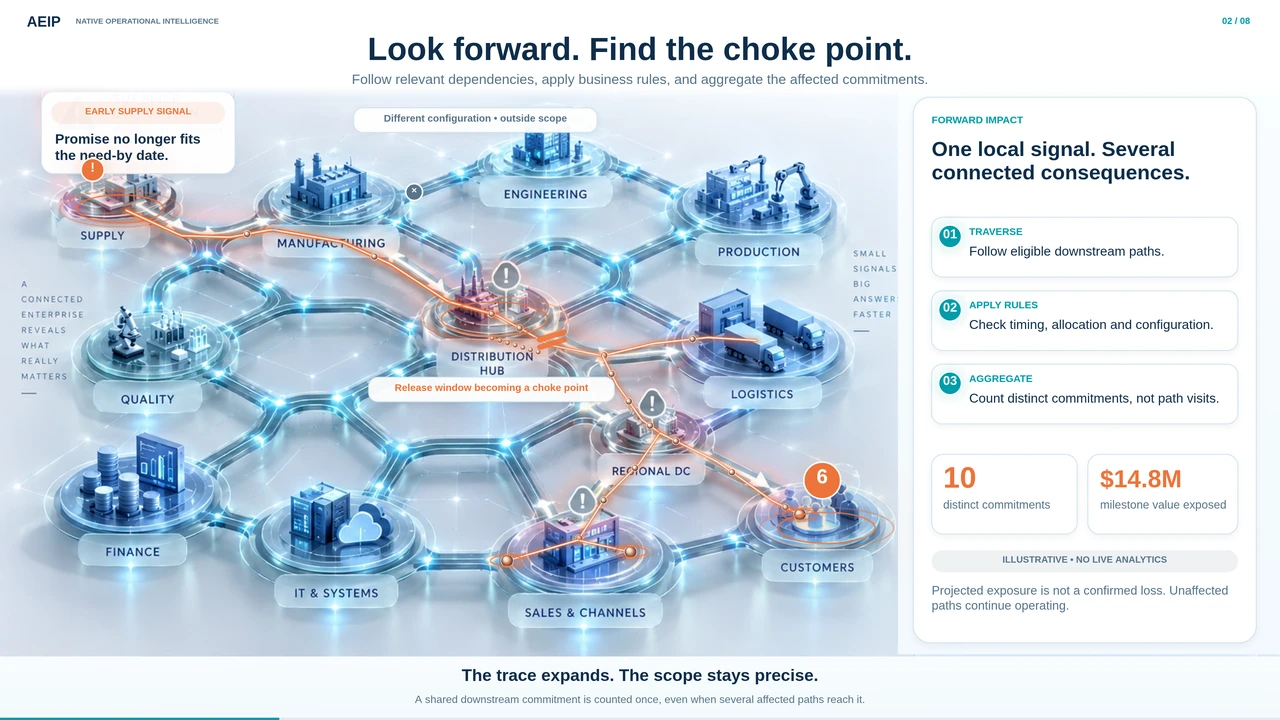
A supply signal becomes a business decision.
Original illustrative artwork · the numbers inside the image are a fixed reference view.
Illustrative executive visual. Use the buttons to change the story framing while this reference view keeps the full value stream visible.
The consequence
Eight commitments share the same late material. Testing limits the recovery.
8
deliveries exposed
$3.2M
milestone cash at risk of delay
2
constraints—not just a part
Illustrative manufacturing scenario. Fictional data, not customer results. Cash timing is not revenue loss. The value stream is simplified.
Featured executive explainer1:50 Narrated, with on-screen explanations
 Open the executive explainer
See the intelligence autopilot at work.
See the intelligence cycle: an emerging condition, its business impact, a historical investigation, response priorities and learning for the next plan.
Continuous intelligence.
More capacity for coordinated action.
Click to play. No sign-in. A separate illustrative case—not a live product demonstration.
Illustrative scaling ambition—not measured AEIP results. Input indices represent intelligence and coordination effort, not total production costs, labor, or capital.
Continuous intelligence in action
The situation changes.
The intelligence keeps working.
A decision package stays useful only while its assumptions hold. Follow an illustrative aerospace case as AEIP prepares a response, revises it and carries verified experience forward.
- Initial package
- New condition
- Revised response
- Verified learning
One supplier delay becomes a delivery decision.
A release inspection is incomplete. The material is now expected after the planned build start, putting the reserved test slot and a customer commitment at risk.
AEIP’s ongoing work
AEIP links the supplier evidence to assembly, testing and delivery, traces the recorded release blockage and prepares recovery options. Unresolved causes remain visible.
Package 1 · PreparedResequence assembly or expedite released material.
Compare the delivery effect, added cost and prerequisites. The proposed recovery currently depends on the reserved test slot.
- Signal
- Supplier delay
- Impact
- Delivery exposure
- Cause investigation
- Release evidence linked
- Decision package
- Prepared
AEIP has prepared the options. The program owner retains authority to select a response and authorize action.
Experience behind the platform
Harpreet Singh & Paramdeep Singh
Complex problems. Enterprise-scale stakes.
≈1 week → ≈4 hours
Impact-scenario preparation in prior aerospace work.
30 years each
Of major-enterprise problem-solving experience.
Founder-reported prior-role experience and team contributions—not AEIP product results. The aerospace work involved a $200–$300M problem scope; this is not a claim of savings or complete resolution.
Connected operational knowledge
What each part knows.
What their relationships reveal.
Not just a wider view of separate information. Evidence-backed understanding of what depends on what—and what those dependencies mean together.
The depth within one business function
More than a domain-level total.
Understand the dependencies between a function’s subdomains, activities, resources and applications. Even within production, a capacity total is not the same as a workable sequence.
The operational questionWhich work can proceed with the available tooling, qualified resources and sequencing constraints?
Illustrative explanation. Domain boundaries vary by organization.
Meaning, not just aggregationA supported view of executable work.
Connect the conditions that must hold together.
Understanding between the functions
The combined consequence may not be stated anywhere.
Supply, quality, production and acceptance can each hold valid information. Their joint effect on a customer commitment still has to be established.
The operational questionWill recovering material actually recover the commitment—or does another dependency still limit the result?
A connection is a starting point. Conclusions need evidence, domain logic and validation.
What their relationships revealLocal readiness does not establish end-to-end readiness.
Assess which coordinated changes could alter the business outcome.
From one investigation to the next decision
Reuse what remains valid. Re-examine what changed.
Relevant history helps investigate how a condition arose. Verified experience helps evaluate a new situation—without treating yesterday’s answer as automatically correct today.
The operational questionUnder which conditions did an intervention work, what else did it affect, and do those conditions still apply?
Missing history is disclosed, not invented. Prior success is not permission to act.
Conditions, dependencies and evidence.
Decisions, human changes and observed outcomes.
Check applicability. Adapt or retire the pattern.
Retained through the Operational Intelligence HubKnowledge informs both execution and the next plan.
Our meaning of operational knowledge
Evidence-backed understanding of operating conditions, dependencies, decisions and outcomes. AEIP’s scope includes understanding within domains and the additional meaning established by examining how domains interact.
A concrete manufacturing example
Recovering the part is not the same as recovering the delivery.
A supplier update, a production commitment and a test schedule can each look manageable in isolation. Connect their consequences, and the right recovery decision changes.
The individual records may exist, while the operational knowledge connecting them remains disconnected & undiscovered.
Compare the actual scenario optionsIllustrative scenario · Existing teaching model
Material arrives eight days late.
SUPPLYEight kits are tied to this month’s commitments.
Twelve assemblies are due.
PRODUCTIONOnly four have material available on time.
Eight test slots are available.
TESTExpediting every kit will not recover every delivery.
The connection changes the choiceRecover material and test capacity together.
Compare a $180k expedite with a $120k reallocation-and-testing option. Assess commitments protected, residual exposure and the next-cycle buffer trade-off.
A continuous enterprise intelligence function
One intelligence cycle.
Continuously at work.
AEIP maintains shared operating context, initiates investigations as conditions change and keeps decision packages current. Each capability contributes to the same ongoing intelligence cycle.
What needs to come together for the work to proceed?
Live connected enterpriseKeep requirements, material, configuration, capacity, people and commitments connected, so teams can establish which conditions must hold together.
Which changing conditions need attention now?
Observe, correlate & detectCorrelate emerging conditions across domains and prioritize investigations by their potential consequences and the time available to intervene.
What could this affect across delivery, money and resources?
Blast radius & impactKeep delivery commitments, financial consequences and resource constraints in one assessment. Show where exposure and the next constraint could move, with assumptions visible.
What changed to put us on this path?
Root cause & historical reconstructionReconstruct applicable conditions and what systems had recorded at the time. Test possible causes against evidence, with gaps and assumptions visible.
Which responses are feasible, and what are their trade-offs?
Evidence-backed decision packagesKeep response options current as evidence changes. Compare feasibility, cost, timing and cross-program consequences, with named decision and action owners.
Did the response work, and what should the next plan do differently?
Act, verify, learn & compoundSupport authorized action and verify its effect on the commitment. Reuse validated lessons in the next plan after checking whether their conditions still apply.
The next question builds on the foundation.
Apply native services and connected context to another operational question, with the domain rules, integration and validation it needs.
The next decision builds on validated experience.
Carry supported findings, successful practices and failed-pattern evidence forward. Re-check their scope, conditions and limits.
Platform design intent. “Native” means built into AEIP—not zero-configuration adoption. Actual coverage depends on evidence, integration, domain logic and controls.
Manufacturing · The broader operating scope
One platform.
18 operational outcomes.
The same connected foundation and intelligence capabilities, applied to different operational questions. Start with what you need to protect, improve or scale.
Supply Continuity
- Part Shortage
- Clear to Build
- Supplier Performance
- JIT Delivery
- Supplier Contract Finalized
Inventory & Lifecycle
- Excess Inventory
- Part Obsolescence
- Inventory Discrepancy
- Phase-Out
Quality & Compliance
- Non-Conformance Detected
- Quality Compliance
- Equipment Downtime
Engineering & NPI
- Design Change
- Prototype Validated
Operational Performance
- Production Delay
- On-Time Completion
- Capacity Overload
- Cost Overrun
The value is in how they work together—not in adding up 18 isolated fixes.
Connect the constraints. Compare coordinated responses. Carry the learning into the next plan.
Manufacturing scope, not the platform’s industry boundary. The catalogue includes risks, readiness states and successful outcomes. Each application requires the appropriate evidence, domain rules, integration and validation.
Self-adapting operations
Expand what the business
can actually deliver.
As AEIP takes on the continuing work of detecting change, assessing consequences and preparing responses, people gain capacity for improvement and expansion. Verified operational knowledge makes the next cycle better informed.
Hyper-scaling
operations
Support more programs, sites, partners and change by reusing operational understanding—not recreating the entire investigation for every decision.
The intended operating shiftMore scope. Less repeated reconstruction.
Enabling
massive growth
Establish what must change across the enterprise for added demand, investment or capacity to become completed commitments—not simply more activity.
The intended business shiftFrom expansion plans to executable growth.
Continuous
optimization
Assess coordinated changes across functions. Retain what works, adapt to new conditions and stop repeating practices that inhibit the overall outcome.
The intended performance shiftOptimize the result—not one function’s score.
Intended enterprise outcomes, not guaranteed improvements. Market demand, physical capacity, investment, evidence and human authority still matter.
AEIP · Operational Intelligence Hub
The next decision should not
start from zero.
The Operational Intelligence Hub brings verified experience into the next investigation, decision and plan. As current conditions change, AEIP reassesses which prior findings and response patterns still apply—and retains the outcome of the next cycle.
Execution → intelligence
What operations reveal.
Live operating evidenceRequirements, resources, assets, constraints and commitments within and across business domains.
Verified outcomesWhat changed, what worked, what failed and under which conditions.
Operational
Intelligence Hub
Connected evidence.
Accountable decisions.
Reusable operational knowledge.
Intelligence → planning
What leaders change.
Planning & allocationLead times, capacity, buffers, program priorities and financial assumptions.
Governed return to executionApproved plans, owners, guardrails and actions—not automatic overrides.
A complete two-way operating loop. Execution evidence and verified learning inform strategic planning and allocation. Approved priorities and plans return to governed execution. Verified outcomes inform the next cycle.
Explore the loop Conceptual illustration · no live operating data
What execution teachesWhat each part knows.
What each part knows.
What the dependencies reveal.
Requirements, resources, assets, constraints and commitments provide connected operating evidence. Human expertise and verified outcomes add context: what changed, what worked, what failed and under which conditions.
Knowledge into planningImprove the assumptions.
Improve the assumptions.
Not just the report.
Validated operational knowledge informs capacity, supply, finance, portfolio priorities and risk. Leaders can review lead times, buffers and allocations using the evidence from execution—not automatically accept a recommendation.
Planning back into operationsApproved intent becomes
Approved intent becomes
governed execution.
Approved plans, priorities and allocations return to the connected operating context with named owners, guardrails and actions. People retain authority to challenge assumptions and coordinate changes. Permission to investigate is not permission to change operational systems.
A stronger next cycleKeep the result.
Keep the result.
Keep the conditions.
Retain what was approved, what people changed, what was executed and which outcomes were verified. Reuse effective approaches where conditions support them; adapt or constrain others. The next decision builds on validated experience—not a promise that yesterday’s answer will work again.
Illustrative manufacturing example · A planning assumption is reviewed
01 / Discover
A planning assumption no longer holds.
In the scenario, a 14-day lead-time assumption conflicts with a 32-day median across six recent receipts.
02 / Validate & act
Protect the commitment with controls.
Confirm compatible, released kits. Approve the test slots. Record who changed the plan and the buffer being consumed.
03 / Retain & improve
Change the conditions that created it.
Review the planning parameter, restore the buffer and preserve the intervention’s limits before using it again.
See the next planning cycle
A persistent intelligence capability.
More capacity for prevention, growth and optimization.
Watch the SIOP planning loop · 4:38
Follow a separate planning example: excess inventory and part shortage lead to reviewed assumptions, governed changes and evidence from the next cycle.
Manufacturing illustrations · Start with one consequential decision
Where is the constraint
on your next commitment?
Different operating questions. The same connected foundation, intelligence capabilities and governed learning loop.
Delivery confidence
Which deliveries can we still protect?
Establish which commitments remain achievable. Compare recovery choices across programs, material and testing, with the cost and cash timing of each response.
Deliveries protected · residual exposure · incremental cost
Explore the delivery decision Detailed material-readiness case · 4:23 Executable growth
Will the ramp produce more accepted output?
Test growth plans against material, qualified capacity, sequencing and acceptance. Compare responses by accepted output, operating cost and where the next constraint moves.
Accepted output · bottleneck capacity · operating cost
Explore the ramp decision Detailed production-ramp case · 4:08 Cash conversion
What stands between finished work and cash?
Connect configuration evidence, quality release and customer acceptance to payment. Assign accountable action and verify whether it removes the blocker to cash.
Acceptance-ready units · cash timing · release blockers
Explore the cash decision Detailed delivery-to-cash case · 4:20 One connected context
Different decisions.
Clear accountability.
“Which intervention protects the most important commitments without moving the problem somewhere else?”
Explore AEIP / Choose your depth
Start with the outcome.
Go deeper where it matters.
Follow a case. Explore a capability. Change the situation. Each gives you a different view of the same operating loop.
Start here 1:50 executive explainer
The enterprise gains the ability—not merely the answer.
Impact. Prioritization. Historical investigation. Accountable action. Reusable learning.
Then explore a specific decision · 90 seconds
Which deliveries can we still protect?
A business commitment, a hidden constraint, an accountable decision—and the next plan.
 DEEPER USE-CASE WALKTHROUGHS
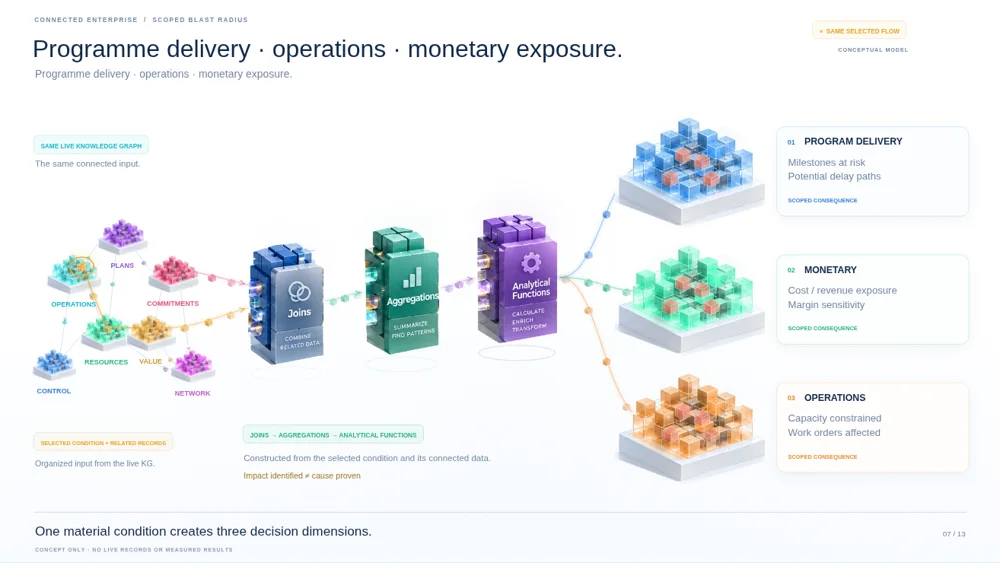
01 / Follow the connected evidenceThe material exists.
The material exists.
The work still cannot proceed.
See how eligibility, allocation and timing change the delivery answer. Follow the evidence through impact, investigation, a decision and retained learning.
Open the narrated case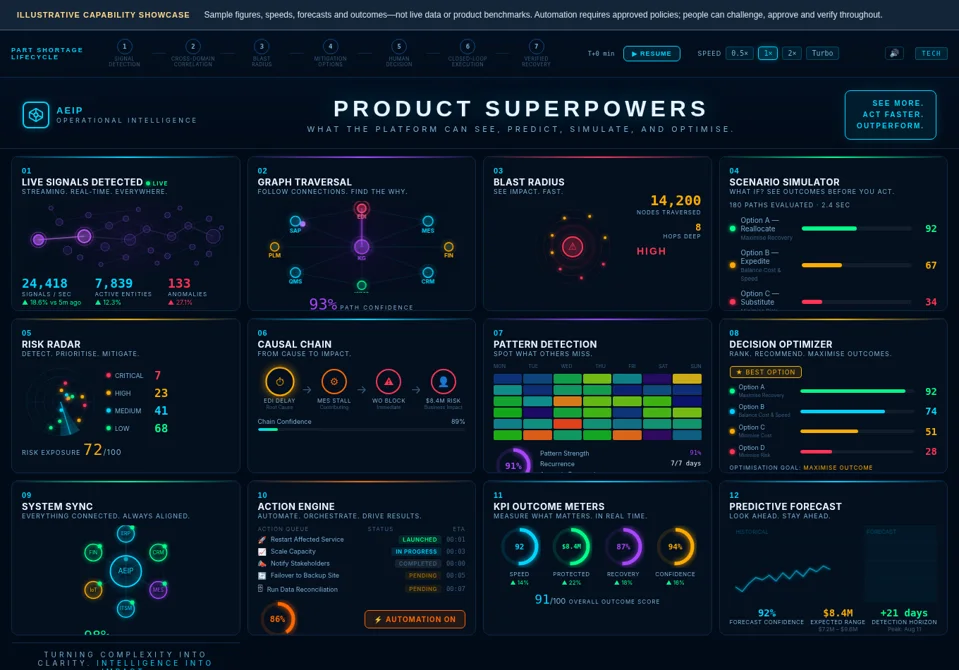 CAPABILITY SHOWCASE
02 / Explore the superpowersWhat can AEIP connect,
What can AEIP connect,
investigate and reveal?
Go beyond the outcome. Explore the existing interactive showcase of signals, graph traversal, blast radius, options, decisions, execution and learning.
Explore the superpowers12 panels · 7 lifecycle stages · narration
 INTERACTIVE SCENARIO EXPLORER
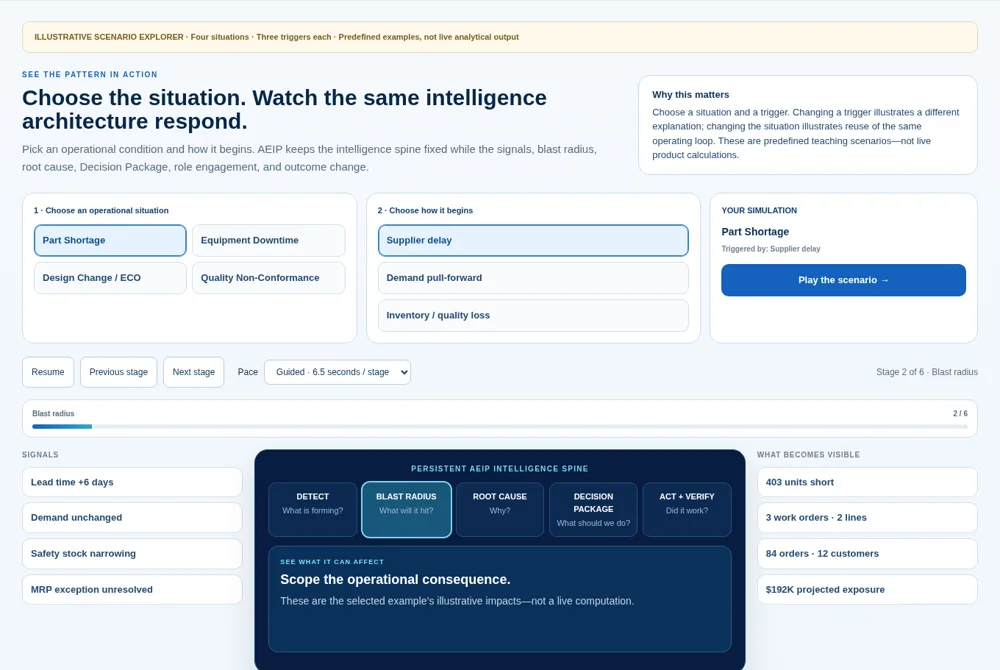
03 / Change the situationDifferent triggers.
Different triggers.
The same operating loop.
Change the condition or how it begins. Compare what changes in the signals, explanation, exposure and decision—and what stays reusable.
Open the simulator4 operating situations · 3 triggers each
All experiences are illustrative. They explain intended capabilities, scenarios and decision logic—not live product performance or customer results. Separate cases retain their own records and assumptions.
Explore the planning feedback loopAutonomous operational intelligence in your industry
The application changes.
The connected capability is reused.
The intelligence cycle is reusable. The dependencies, evidence and decision rights reflect how your industry operates. Explore focused illustrations of the capability in different contexts.
Production ramp readiness
Aerospace Manufacturing
See what must come together to deliver more accepted hardware.
2:08 · Brian narrationWatch the narrated demoDelivery & phased capacity readiness
Data Centers
Do not confuse project progress with capacity released.
Explore the applicationGoverned operational readiness
Nuclear
Protect the outage plan. Preserve the governance.
Explore the applicationMedical-device component continuity
Supply Chain
Protect continuity of care without scaling coordination complexity.
Explore the applicationManufacturing is the illustrated value stream on this homepage.Explore delivery, ramp and cash scenarios
Build on the enterprise you already run
Keep your systems.
Connect their operational meaning.
AEIP adds a continuous operational intelligence function across your enterprise. It connects evidence and operational meaning from the systems you already use, then maintains the intelligence cycle within the scope and authority your enterprise defines.
Start with the right evidence.
Reuse suitable lake, lakehouse, operational data store and event investments. Add source integrations only where needed. Scope the first outcome around the data actually available.
Keep authority explicit.
AEIP runs the intelligence cycle continuously. Your enterprise defines decision rights, action authority and approved workflows, while verified outcomes inform the next investigation and plan.
Use AI where it helps.
AI agents are intended to accelerate repeatable investigation and coordination, alongside rules, analytics and governed workflows. Evidence and human accountability remain essential.
For technology leaders: where AEIP fits
Existing enterprise landscape
Applications & data investments
ERP · PLM · MES · QMS · supply chain · finance
Lake / lakehouse · operational data store · event platforms · approved APIs and change feeds.
AEIP platform
Connected operating context
Identity, relationships, evidence, history and source lineage support detection, impact assessment and investigation.
Operational Intelligence Hub
Decision options, human approvals, actions, verification and retained learning.
Governed business interfaces
Execution ⇄ planning
Approved actions return to operating workflows.
Verified knowledge informs sales and operations planning, capacity, finance, portfolio and strategy. Approved priorities return to execution.
Operational evidence → connected knowledge → governed decisions → verified outcomes → better plans → execution
Reference architecture and design intent. Integration, latency, history coverage, workflow write-back and deployment controls are confirmed in discovery. Prior-state reconstruction is limited by retained evidence; missing history is disclosed, not invented.
Model choice and deployment are intended to support enterprise-approved models and sovereignty objectives. Operational knowledge should persist independently of an individual model. Specific processing, retention, portability and access controls must be agreed and validated.
Six capabilities. One reusable operating loop.
01 / Foundation
Live connected enterprise
Maintain relevant entities, relationships, operating conditions and evidence across domains.
02 / Detect
Observe, correlate & detect
Detect meaningful cross-domain changes and initiate investigation, with uncertainty made explicit.
03 / Consequence
Blast radius & impact
Reassess effects across program delivery, monetary exposure and operations as evidence changes.
04 / Investigate
Root cause & historical reconstruction
Reconstruct relevant prior states and test candidate causes against retained evidence.
05 / Decide
Evidence-backed decision packages
Prepare and update options, costs, trade-offs, owners, approvals and verification conditions.
06 / Compound
Act, verify, learn & compound
Support authorized action and retain verified outcomes, conditions and limits for future use.
The operational configuration changes by outcome. The framework is implementation-agnostic; AEIP is the software platform implementing it.
Explore AEIP for your business
Start with your
operating priorities.
Share what you want to protect, improve or scale. We’ll explore how work moves across your business and where continuous operational intelligence could create the most value.
Read AEIP at a glance One-page PDF
Begin with the operating context. Find where the capability can help. Define a useful first evaluation together.
A focused working discussion.
01
What you want to protect, improve or scale.
02
How work and decisions move across the business.
03
Where a useful first evaluation could begin.
Pilot scope and timing follow a data-readiness assessment. No promise of an outcome before its evidence and constraints are understood.
AEIP in action / executive walkthrough
Which deliveries can we still protect?
A late part is only the beginning. Follow the evidence to a better recovery decision—and a better next plan.
Fictional data and simplified, deterministic models illustrate the intended operating loop. They do not establish live product performance, customer results or guaranteed benefits. Readiness, approval and verification gates remain essential.
Read the complete story · no playback required
The decision, made inspectable
Change the choice.
See what actually changes.
The guided story follows the coordinated option. This independent model lets you test alternatives; it does not change the story above.
Transparent scenario model
Test the constraint—not the slogan.
Change an assumption. The arithmetic is shown alongside the result.
Where does this question show up in your business?
Start with your operating constraint, not a platform-wide implementation.
The text view is the clearest starting point on a small screen. Open any chapter in the visual experience, with narration where available.
Preparing this experience.
Only the selected experience is loaded. Its original controls remain available.
Use the controls inside the experience to play, pause, seek and explore. Leaving this view unloads it and stops its audio.
Aerospace manufacturing / Business responsibilities
What AEIP helps your teams establish and act on
From protecting a delivery to preparing the next increase in output, the same six capabilities work together. Start with the question your teams need to answer.
Readiness and growth
Establish what is achievable now—and what the next increase requires.
Build and Delivery ReadinessWhat can we actually build and deliver?
- Connected conditions
- Requirements, material, configuration, qualified capacity, people and customer commitments.
- Intelligence for action
- AEIP supports a connected readiness view: what can proceed, what is preventing it, and which options existing resources could support.
- Evidence and assumptions
- A component's status is one input. Readiness depends on the applicable configuration, qualifications and conditions holding together.
Production Ramp and Growth ReadinessWhat must change before we can deliver more?
- Connected conditions
- Planned starts, accepted output, repeat work, qualified capacity, material availability, investment and demand.
- Intelligence for action
- AEIP supports comparison of the operating changes needed for higher output, their economics and the next constraint each increase could expose.
- Evidence and assumptions
- More starts do not establish more accepted hardware. Test the required capacity, yield, resources and approvals against the proposed ramp.
Early warning and business consequences
See which conditions matter and what they could change across the business.
Early Warning and Risk PrioritizationWhich changing conditions need our attention first?
- Connected conditions
- Signals from suppliers, production, quality, engineering and delivery, together with their dependencies and timing.
- Intelligence for action
- AEIP supports identification and prioritization of emerging conditions that could threaten commitments while there is time to intervene.
- Evidence and assumptions
- Investigation priority should reflect consequence, urgency and evidence strength. A warning still needs a supported explanation.
Cross-Program Delivery ImpactWill one program's recovery put another commitment at risk?
- Connected conditions
- Shared parts, configurations, test slots, resource allocations and the aircraft, programs and customers that depend on them.
- Intelligence for action
- AEIP supports tracing the affected commitments and the ones that remain protected, including consequences of reallocating shared resources.
- Evidence and assumptions
- Assess proposed recovery against the other commitments it touches. Keep exposure estimates tied to the applicable schedule and dependencies.
Delivery-Linked Financial ImpactWhat does this operating delay mean for revenue, cash and cost?
- Connected conditions
- Delivery and acceptance milestones, contract terms, billing conditions, payment timing and incremental recovery costs.
- Intelligence for action
- AEIP supports assessment of financial timing and exposure, the portion an intervention could protect and the deadline for acting.
- Evidence and assumptions
- Revenue, earnings and cash effects can differ. Apply the enterprise's accounting assumptions and contract terms, and show what remains uncertain.
Capacity and Resource ImpactIf we make this change, where does the constraint move?
- Connected conditions
- Material allocations, production sequences, test slots, workforce qualifications and unfinished work.
- Intelligence for action
- AEIP supports comparison of how a response changes resource demand and availability across the operating flow.
- Evidence and assumptions
- Check whether a local improvement releases accepted output or creates a queue elsewhere. Use feasible capacity and sequencing assumptions.
Investigation and coordinated response
Establish what changed, compare feasible responses and verify the result.
Root Cause and Change AnalysisWhat changed to put us on this path?
- Connected conditions
- Applicable conditions, dependencies and events with the historical record of when the systems learned about them.
- Intelligence for action
- AEIP supports reconstruction of what was in effect and what had been recorded at the time, so teams can investigate competing explanations.
- Evidence and assumptions
- Distinguish an evidence-supported cause from correlation or an assumption. Make missing history and unsupported links visible.
Response Options and Trade-offsWhich response protects our priorities—and what does it cost elsewhere?
- Connected conditions
- Feasible responses, delivery priorities, financial consequences, operating constraints and other commitments.
- Intelligence for action
- AEIP supports an inspectable decision package that compares options and recommends where to act first, with the trade-offs explained.
- Evidence and assumptions
- Keep rankings tied to the current priorities, assumptions and constraints. Reassess a response when its feasibility or consequences change.
Coordinated Action and Outcome VerificationDid the action protect the commitment, or did we only close the task?
- Connected conditions
- The selected response, named owners, required approvals, execution evidence and the commitment it is intended to protect.
- Intelligence for action
- AEIP supports coordinated follow-through and verification of the operating result, with unresolved conditions available for further action.
- Evidence and assumptions
- The enterprise governs action. Verify the intended outcome against agreed criteria; task completion alone does not establish success.
Learning and better plans
Make the next operating decision benefit from what execution taught you.
Operational Learning and Planning ImprovementWhat should the next plan do differently because of what we learned?
- Connected conditions
- Decision evidence, actions, verified outcomes and the assumptions behind planning, priorities and resource allocations.
- Intelligence for action
- The Operational Intelligence Hub supports reuse of relevant knowledge and feedback into the next plan, with revised priorities returned for governed execution.
- Evidence and assumptions
- Check whether the earlier conditions still apply. Retain what worked, what failed and what remains uncertain before reusing a response.
One reusable framework, applied to your operating questions. These business responsibilities draw on the six AEIP capabilities. The demo illustrates that approach; an enterprise implementation uses its own connected evidence, policies and authorized decisions.