Operational intelligence for enterprise growth and scale
Put connected
operational knowledge
to work.
Within business domains. Across their dependencies. Over time.
Knowing how each part of the business operates is not the same as understanding what their combined conditions mean for the outcome.
AEIP is designed to make discovering and applying that connected operational knowledge a native, reusable enterprise capability—revealing what limits performance, what makes growth executable, and which coordinated actions can improve the result.
1:50 illustrative executive explainer · Click to play · No sign-in
01
Hyper-scaling operationsExtend understanding without repeating all the work.
02
Enabling massive growthMake the next stage of expansion executable.
03
Continuous optimizationImprove the whole outcome—not just one metric.
One application · Manufacturing
Explore other operating contexts The value stream below illustrates the broader capability. It does not define its industry boundary.
One connected view of a manufacturing value stream
A supply signal becomes a business decision.
Original illustrative artwork · the numbers inside the image are a fixed reference view.
Illustrative executive visual. Use the buttons to change the story framing while this reference view keeps the full value stream visible.
The consequence
Eight commitments share the same late material. Testing limits the recovery.
8
deliveries exposed
$3.2M
milestone cash at risk of delay
2
constraints—not just a part
Illustrative manufacturing scenario. Fictional data, not customer results. Cash timing is not revenue loss. The value stream is simplified.
Featured executive explainer1:50 Silent, with on-screen explanations
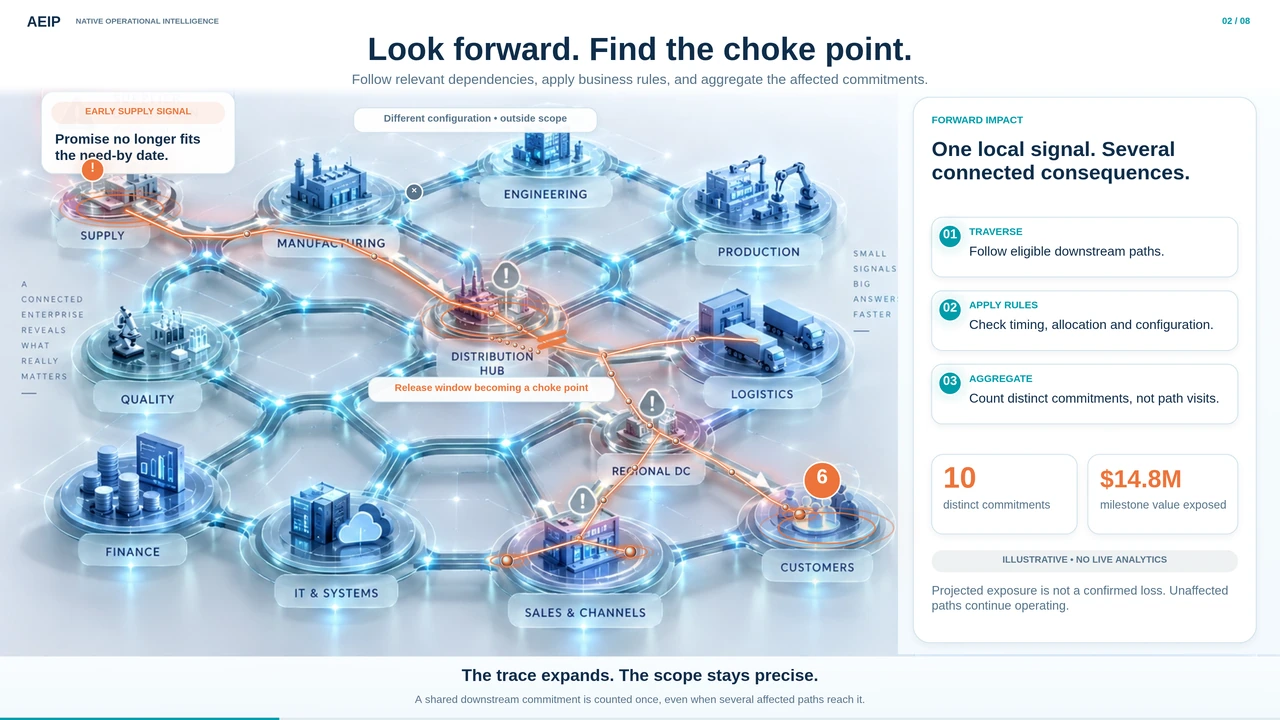 Open the executive explainer
See what connected operational knowledge makes possible.
Follow an emerging constraint through business impact, action priorities, historical investigation, and learning that improves the next plan.
Connections are the foundation.
Accountable action makes the difference.
Click to play. No sign-in. A separate illustrative case—not a live product demonstration.
Illustrative scaling ambition—not measured AEIP results. Input indices represent intelligence and coordination effort, not total production costs, labor, or capital.
Experience behind the platform
Harpreet Singh & Paramdeep Singh
Complex problems. Enterprise-scale stakes.
≈1 week → ≈4 hours
Impact-scenario preparation in prior aerospace work.
30 years each
Of major-enterprise problem-solving experience.
Founder-reported prior-role experience and team contributions—not AEIP product results. The aerospace work involved a $200–$300M problem scope; this is not a claim of savings or complete resolution.
Connected operational knowledge
What each part knows.
What their relationships reveal.
Not just a wider view of separate information. Evidence-backed understanding of what depends on what—and what those dependencies mean together.
The depth within one business function
More than a domain-level total.
Understand the dependencies between a function’s subdomains, activities, resources and applications. Even within production, a capacity total is not the same as a workable sequence.
The operational questionWhich work can proceed with the available tooling, qualified resources and sequencing constraints?
Illustrative explanation. Domain boundaries vary by organization.
Meaning, not just aggregationA supported view of executable work.
Connect the conditions that must hold together.
Understanding between the functions
The combined consequence may not be stated anywhere.
Supply, quality, production and acceptance can each hold valid information. Their joint effect on a customer commitment still has to be established.
The operational questionWill recovering material actually recover the commitment—or does another dependency still limit the result?
A connection is a starting point. Conclusions need evidence, domain logic and validation.
What their relationships revealLocal readiness does not establish end-to-end readiness.
Assess which coordinated changes could alter the business outcome.
From one investigation to the next decision
Reuse what remains valid. Re-examine what changed.
Relevant history helps investigate how a condition arose. Verified experience helps evaluate a new situation—without treating yesterday’s answer as automatically correct today.
The operational questionUnder which conditions did an intervention work, what else did it affect, and do those conditions still apply?
Missing history is disclosed, not invented. Prior success is not permission to act.
Conditions, dependencies and evidence.
Decisions, human changes and observed outcomes.
Check applicability. Adapt or retire the pattern.
Retained through the Operational Intelligence HubKnowledge informs both execution and the next plan.
Our meaning of operational knowledge
Evidence-backed understanding of operating conditions, dependencies, decisions and outcomes. AEIP’s scope includes understanding within domains and the additional meaning established by examining how domains interact.
A concrete manufacturing example
Recovering the part is not the same as recovering the delivery.
A supplier update, a production commitment and a test schedule can each look manageable in isolation. Connect their consequences, and the right recovery decision changes.
The individual records may exist, while the operational knowledge connecting them remains disconnected & undiscovered.
Compare the actual scenario optionsIllustrative scenario · Existing teaching model
Material arrives eight days late.
SUPPLYEight kits are tied to this month’s commitments.
Twelve assemblies are due.
PRODUCTIONOnly four have material available on time.
Eight test slots are available.
TESTExpediting every kit will not recover every delivery.
The connection changes the choiceRecover material and test capacity together.
Compare a $180k expedite with a $120k reallocation-and-testing option. Assess commitments protected, residual exposure and the next-cycle buffer trade-off.
A new enterprise capability
The enterprise gains the ability.
Not merely the answer.
AEIP implements one reusable operating framework. Its native capabilities work from shared context—not a separately invented intelligence system for every question.
Live connected enterprise
Connect entities, dependencies, present conditions and available history within and across domains.
Observe, correlate & detect
Find emerging conditions and opportunities whose significance may not be visible in a local view.
Blast radius & impact
Trace consequences for commitments, monetary exposure and operations. Preserve the scope and assumptions.
Root cause & historical reconstruction
Reconstruct relevant prior conditions and test explanations against available evidence—not correlation alone.
Evidence-backed decision packages
Compare options, costs, trade-offs, timing and uncertainty, with named decision, action and verification owners.
Act, verify, learn & compound
Support authorized action. Retain human changes and verified outcomes. Reuse, adapt or constrain patterns.
The next question builds on the foundation.
Apply native services and connected context to another operational question, with the domain rules, integration and validation it needs.
The next decision builds on validated experience.
Carry supported findings, successful practices and failed-pattern evidence forward. Re-check their scope, conditions and limits.
Platform design intent. “Native” means built into AEIP—not zero-configuration adoption. Actual coverage depends on evidence, integration, domain logic and controls.
Harness untapped operational potential
Expand what the business
can actually deliver.
Less repeated investigation is a mechanism. The ambition is greater operating capability: growth that can be executed and performance that can keep improving.
Hyper-scaling
operations
Support more programs, sites, partners and change by reusing operational understanding—not recreating the entire investigation for every decision.
The intended operating shiftMore scope. Less repeated reconstruction.
Enabling
massive growth
Establish what must change across the enterprise for added demand, investment or capacity to become completed commitments—not simply more activity.
The intended business shiftFrom expansion plans to executable growth.
Continuous
optimization
Assess coordinated changes across functions. Retain what works, adapt to new conditions and stop repeating practices that inhibit the overall outcome.
The intended performance shiftOptimize the result—not one function’s score.
Intended enterprise outcomes, not guaranteed improvements. Market demand, physical capacity, investment, evidence and human authority still matter.
AEIP · Operational Intelligence Hub
The next decision should not
start from zero.
The Operational Intelligence Hub connects what execution teaches with how the business plans, allocates and operates next. It retains validated knowledge—not just a history of incidents.
Execution → intelligence
What operations reveal.
Live operating evidenceRequirements, resources, assets, constraints and commitments within and across business domains.
Verified outcomesWhat changed, what worked, what failed and under which conditions.
Operational
Intelligence Hub
Connected evidence.
Accountable decisions.
Reusable operational knowledge.
Intelligence → planning
What leaders change.
Planning & allocationLead times, capacity, buffers, program priorities and financial assumptions.
Governed return to executionApproved plans, owners, guardrails and actions—not automatic overrides.
A complete two-way operating loop. Execution evidence and verified learning inform strategic planning and allocation. Approved priorities and plans return to governed execution. Verified outcomes inform the next cycle.
Explore the loop Conceptual illustration · no live operating data
What execution teachesWhat each part knows.
What each part knows.
What the dependencies reveal.
Requirements, resources, assets, constraints and commitments provide connected operating evidence. Human expertise and verified outcomes add context: what changed, what worked, what failed and under which conditions.
Knowledge into planningImprove the assumptions.
Improve the assumptions.
Not just the report.
Validated operational knowledge informs capacity, supply, finance, portfolio priorities and risk. Leaders can review lead times, buffers and allocations using the evidence from execution—not automatically accept a recommendation.
Planning back into operationsApproved intent becomes
Approved intent becomes
governed execution.
Approved plans, priorities and allocations return to the connected operating context with named owners, guardrails and actions. People retain authority to challenge assumptions and coordinate changes. Permission to investigate is not permission to change operational systems.
A stronger next cycleKeep the result.
Keep the result.
Keep the conditions.
Retain what was approved, what people changed, what was executed and which outcomes were verified. Reuse effective approaches where conditions support them; adapt or constrain others. The next decision builds on validated experience—not a promise that yesterday’s answer will work again.
Illustrative manufacturing example · A planning assumption is reviewed
01 / Discover
A planning assumption no longer holds.
In the scenario, a 14-day lead-time assumption conflicts with a 32-day median across six recent receipts.
02 / Validate & act
Protect the commitment with controls.
Confirm compatible, released kits. Approve the test slots. Record who changed the plan and the buffer being consumed.
03 / Retain & improve
Change the conditions that created it.
Review the planning parameter, restore the buffer and preserve the intervention’s limits before using it again.
See the next planning cycle
Not just faster investigation. Less repeated reconstruction.
More capacity for prevention, growth and optimization.
Watch the SIOP planning loop · 4:38
Follow a separate planning example: excess inventory and part shortage lead to reviewed assumptions, governed changes and evidence from the next cycle.
Manufacturing illustrations · Start with one consequential decision
Where is the constraint
on your next commitment?
Different operating questions. The same connected foundation, intelligence capabilities and governed learning loop.
Delivery confidence
Which deliveries can we still protect?
Trace a late part to customer commitments. Compare recovery choices across material, testing and cash timing.
Deliveries protected · residual exposure · incremental cost
Explore the delivery decision Detailed material-readiness case · 4:23 Executable growth
Will the ramp produce more accepted output?
Separate local production capacity from end-to-end throughput. Find the constraint that actually limits growth.
Accepted output · bottleneck capacity · operating cost
Explore the ramp decision Detailed production-ramp case · 4:08 Cash conversion
What stands between finished work and cash?
Connect configuration evidence, quality release and customer acceptance to the milestone that enables payment.
Acceptance-ready units · cash timing · release blockers
Explore the cash decision Detailed delivery-to-cash case · 4:20 One connected context
Different decisions.
Clear accountability.
“Which intervention protects the most important commitments without moving the problem somewhere else?”
Explore AEIP / Choose your depth
Start with the outcome.
Go deeper where it matters.
Follow a case. Explore a capability. Change the situation. Each gives you a different view of the same operating loop.
Start here 1:50 executive explainer
The enterprise gains the ability—not merely the answer.
Impact. Prioritization. Historical investigation. Accountable action. Reusable learning.
Then explore a specific decision · 90 seconds
Which deliveries can we still protect?
A business commitment, a hidden constraint, an accountable decision—and the next plan.
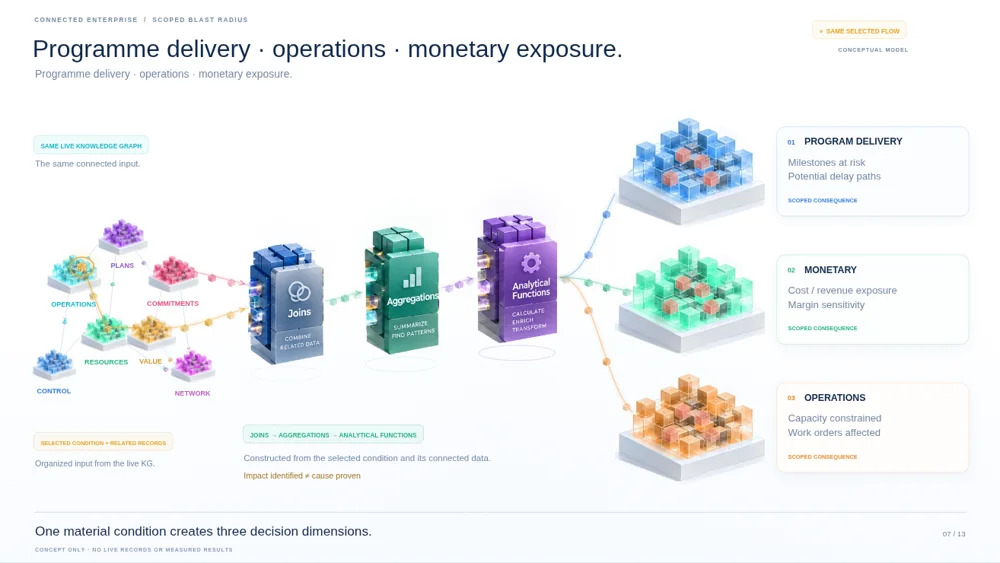 DEEPER USE-CASE WALKTHROUGHS
01 / Follow the connected evidenceThe material exists.
The material exists.
The work still cannot proceed.
See how eligibility, allocation and timing change the delivery answer. Follow the evidence through impact, investigation, a decision and retained learning.
Open the narrated case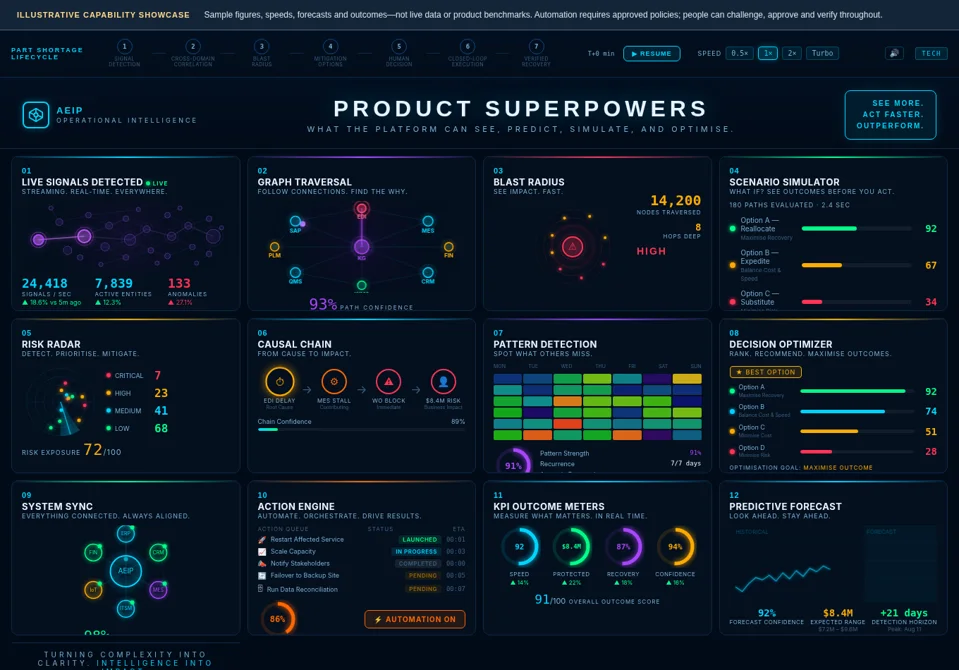 CAPABILITY SHOWCASE
02 / Explore the superpowersWhat can AEIP connect,
What can AEIP connect,
investigate and reveal?
Go beyond the outcome. Explore the existing interactive showcase of signals, graph traversal, blast radius, options, decisions, execution and learning.
Explore the superpowers12 panels · 7 lifecycle stages · narration
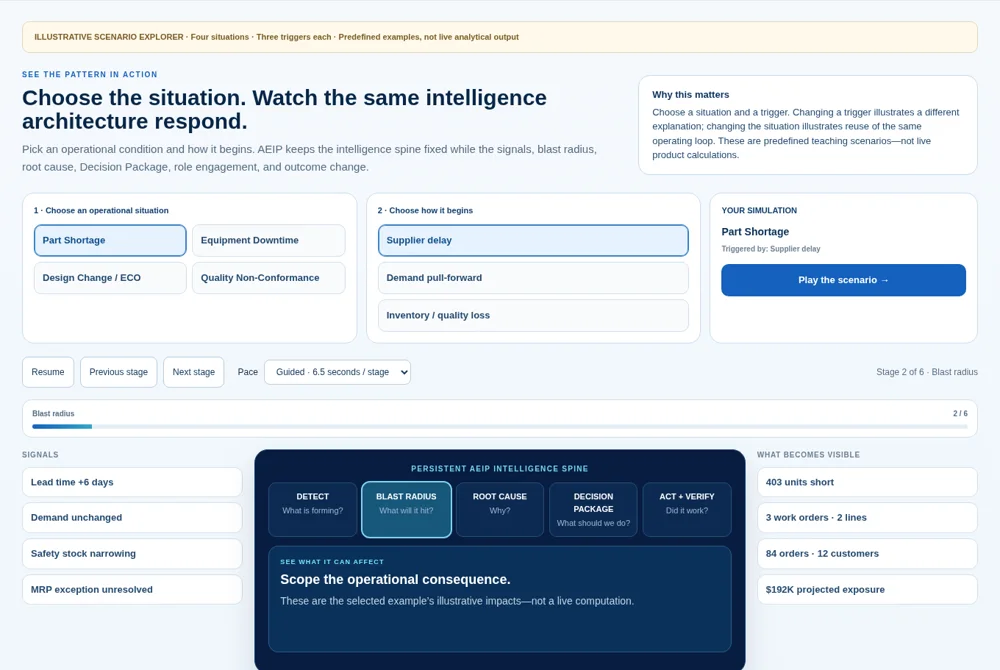 INTERACTIVE SCENARIO EXPLORER
03 / Change the situationDifferent triggers.
Different triggers.
The same operating loop.
Change the condition or how it begins. Compare what changes in the signals, explanation, exposure and decision—and what stays reusable.
Open the simulator4 operating situations · 3 triggers each
All experiences are illustrative. They explain intended capabilities, scenarios and decision logic—not live product performance or customer results. Separate cases retain their own records and assumptions.
Explore the planning feedback loopOne reusable foundation · Different operating contexts
The application changes.
The connected capability is reused.
The operating rules, evidence and authority vary by context. Explore focused illustrations—not a claim of completed deployments in every industry.
Delivery & phased capacity readiness
Data Centers
Do not confuse project progress with capacity released.
Explore the applicationGoverned operational readiness
Nuclear
Protect the outage plan. Preserve the governance.
Explore the applicationMedical-device component continuity
Supply Chain
Protect continuity of care without scaling coordination complexity.
Explore the applicationManufacturing is the illustrated value stream on this homepage.Explore delivery, ramp and cash scenarios
Build on the enterprise you already run
Keep your systems.
Connect their operational meaning.
AEIP is an operational-intelligence software platform implementing a reusable six-capability framework. Connect domain evidence and derive supported meaning without replacing existing execution systems or accountable people.
Start with the right evidence.
Reuse suitable lake, lakehouse, operational data store and event investments. Add source integrations only where needed. Scope the first outcome around the data actually available.
Keep authority explicit.
People validate evidence, challenge conclusions, approve trade-offs and govern execution. Retain changes, approvals and verified outcomes as connected operational knowledge.
Use AI where it helps.
AI agents are intended to accelerate repeatable investigation and coordination, alongside rules, analytics and governed workflows. Evidence and human accountability remain essential.
For technology leaders: where AEIP fits
Existing enterprise landscape
Applications & data investments
ERP · PLM · MES · QMS · supply chain · finance
Lake / lakehouse · operational data store · event platforms · approved APIs and change feeds.
AEIP platform
Connected operating context
Identity, relationships, evidence, history and source lineage support detection, impact assessment and investigation.
Operational Intelligence Hub
Decision options, human approvals, actions, verification and retained learning.
Governed business interfaces
Execution ⇄ planning
Approved actions return to operating workflows.
Verified knowledge informs sales and operations planning, capacity, finance, portfolio and strategy. Approved priorities return to execution.
Operational evidence → connected knowledge → governed decisions → verified outcomes → better plans → execution
Reference architecture and design intent. Integration, latency, history coverage, workflow write-back and deployment controls are confirmed in discovery. Prior-state reconstruction is limited by retained evidence; missing history is disclosed, not invented.
Model choice and deployment are intended to support enterprise-approved models and sovereignty objectives. Operational knowledge should persist independently of an individual model. Specific processing, retention, portability and access controls must be agreed and validated.
Six capabilities. One reusable operating loop.
01 / Foundation
Live connected enterprise
Maintain relevant entities, relationships, operating state and evidence across domains.
02 / Detect
Observe, correlate & detect
Connect signals that become meaningful together, with uncertainty made explicit.
03 / Consequence
Blast radius & impact
Assess effects across program delivery, monetary exposure and operations.
04 / Investigate
Root cause & historical reconstruction
Trace contributing factors through available prior-state evidence and test candidate explanations.
05 / Decide
Evidence-backed decision packages
Present options, costs, trade-offs, owners, approvals and verification conditions.
06 / Compound
Act, verify, learn & compound
Retain outcomes and their conditions. Reuse effective patterns; constrain failed ones.
The operational configuration changes by outcome. The framework is implementation-agnostic; AEIP is the software platform implementing it.
Make the first conversation concrete
One growth question.
A more connected decision.
Bring a delivery, capacity, readiness, service or optimization challenge. Establish what each domain knows, what their dependencies reveal, and which coordinated action is worth testing.
Read AEIP at a glance One-page PDF
Start narrowly. Establish the baseline. Prove a useful result.
Then assess reuse on the same foundation.
A focused working discussion.
01
The commitment or outcome at stake.
02
The dependencies and evidence needed.
03
The scope, ownership and success measures.
Pilot scope and timing follow a data-readiness assessment. No promise of an outcome before its evidence and constraints are understood.
AEIP in action / executive walkthrough
Which deliveries can we still protect?
A late part is only the beginning. Follow the evidence to a better recovery decision—and a better next plan.
Fictional data and simplified, deterministic models illustrate the intended operating loop. They do not establish live product performance, customer results or guaranteed benefits. Readiness, approval and verification gates remain essential.
Read the complete story · no playback required
The decision, made inspectable
Change the choice.
See what actually changes.
The guided story follows the coordinated option. This independent model lets you test alternatives; it does not change the story above.
Transparent scenario model
Test the constraint—not the slogan.
Change an assumption. The arithmetic is shown alongside the result.
Where does this question show up in your business?
Start with your operating constraint, not a platform-wide implementation.
The text view is the clearest starting point on a small screen. Open any chapter in the visual experience, with narration where available.
Preparing this experience.
Only the selected experience is loaded. Its original controls remain available.
Use the controls inside the experience to play, pause, seek and explore. Leaving this view unloads it and stops its audio.