A neutron can trigger fission in a suitable heavy nucleus.
A fissile nucleus absorbs a neutron and splits. The fragments carry energy, and additional neutrons are released.
What the animation shows: A neutron approaches a suitable heavy nucleus, which splits into fragments and releases additional neutrons. The drawing is schematic rather than an exact particle yield or energy scale.
020:07–0:15
One event can lead to many.
Released neutrons can trigger further fissions.
A branching chain makes the multiplying sequence visible. This is a simplified illustration—not an exact neutron yield, reactor model, or physical time scale.
What the animation shows: The released neutrons branch toward additional nuclei, making a growing sequence of fission events visible. This is an explanatory illustration, not a reactor model or an indefinitely growing operating state.
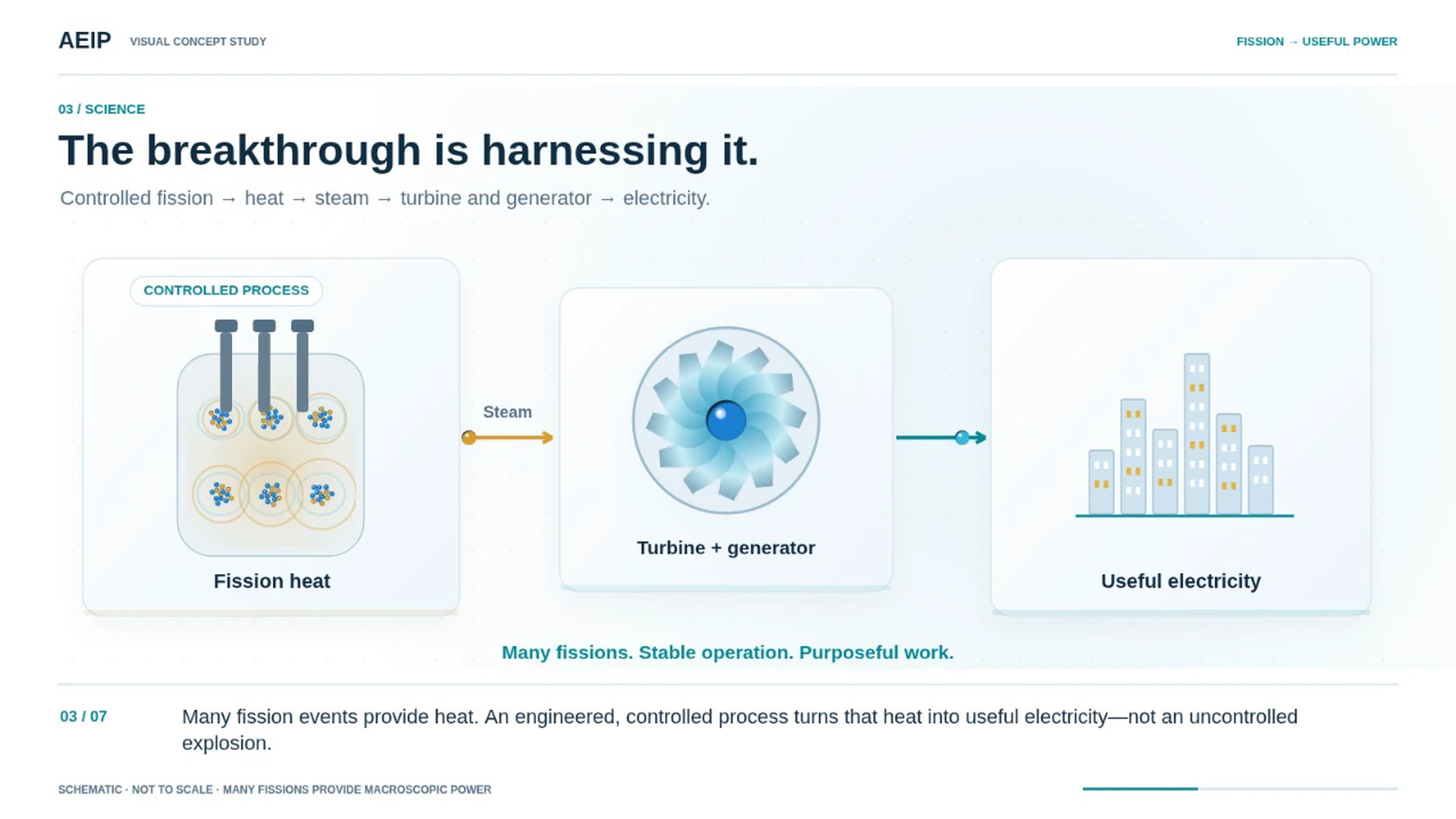
Many fission events provide heat. An engineered, controlled process turns that heat into useful electricity—not an uncontrolled explosion.
What the animation shows: The composition changes from branching to a controlled process: heat, steam, a turbine and generator, then useful electricity. Many fissions provide macroscopic power.
040:22–0:26
Potential is not the same as capability.
Having the potential is different from having the means to put it to work.
The analogy now changes from physical energy to operational potential. The point is acquiring a usable capability, not equating connected data with nuclear energy.
What the animation shows: A visible transition marks the change from physical science to the AEIP metaphor. The common idea is gaining the means to put potential to work, not equating information with nuclear energy.
050:26–0:34
Each function sees a piece.
Connect meaning within domains—and across the dependencies between them.
Illustrative growth question: supply, quality and assembly can each look ready while limited acceptance capacity still blocks the delivery. The combined meaning is not contained in one local status.
What the animation shows: Four domain panels—Supply, Quality, Production and Acceptance—connect. The example reveals that material and assembly readiness do not establish delivery readiness when acceptance capacity remains constrained.
060:34–0:43
Trace the consequence. Investigate why.
Forward impact and backward evidence serve different purposes.
Impact analysis follows the dependency to a business commitment. Historical and root-cause investigation examine what changed and test explanations. A connected path alone does not prove a cause.
What the animation shows: A forward path links a capacity condition with the delivery commitment. A separate reverse investigation uses earlier state, change evidence and current state to test explanations. A connected path is not proof of a cause.
070:43–0:52
The enterprise gains the ability.
Not merely one answer. A native, reusable operational capability.
Evidence-backed options, human authority, action and verification feed the Operational Intelligence Hub. Validated learning informs planning; approved priorities return to execution. Scale, growth and optimization are intended outcomes—not guaranteed returns.
What the animation shows: The Operational Intelligence Hub exchanges evidence, learning, approved priorities and governed action between operations and planning. The closing panels identify scale, growth and optimization as intended outcomes, not guaranteed returns.
An analogy, not physical equivalence or a claim of exponential returns. Connecting operational signals does not create energy, automatically establish causes, or guarantee business value. The science and AEIP portions are explicitly separated.
Jump into the original animation ↓
Science notes and analogy boundaries
Science and source basis
The science sequence is a schematic of neutron-induced fission in suitable nuclei. Branching is deliberately simplified; it is not an exact neutron yield, a reactor model, or a time/energy scale. Many fissions—not one atom alone—provide macroscopic power. The controlled-power scene depicts stable operation, not the indefinitely growing chain shown for explanation.
The AEIP section is a conceptual analogy, not physical equivalence or a live product run. Small signals are evidence; connecting them does not create energy, multiply profits, or automatically establish causes. The existing AEIP material-readiness story informs the forward-impact, backward-evidence, decision and learning sequence. The simplified capacity-alignment example here is newly authored, not a customer finding.